Maybe your bunion started as something you barely noticed.
A small bump along the side of your big toe. A pair of shoes that suddenly felt a little tighter. Some soreness after a long day of walking.
So you adjusted.
You bought wider shoes. You stopped wearing certain styles. You avoided activities that made your foot hurt. Maybe you even started walking a little differently without realizing it.
For a while, that may have worked.
But if bunion pain is becoming more frequent, your shoes are increasingly uncomfortable, or your foot is starting to dictate what you can and cannot do, it may be time to stop working around the problem and find out what is actually happening. Persistent discomfort that begins interfering with everyday life is often a sign that foot pain should be evaluated by a podiatrist.
At Pure Podiatry of WNY, we see patients throughout Western New York who have lived with bunion pain much longer than they needed to because they assumed seeing a podiatrist automatically meant surgery.
It doesn’t.
The first step is understanding your foot, why it hurts, and what treatment options may be appropriate for you.
When Should You See a Podiatrist for a Bunion?
You should consider seeing a podiatrist when a bunion causes recurring pain, makes shoes difficult to wear, affects the movement or position of your big toe, changes the way you walk, or begins interfering with everyday activities.
Not every bunion requires surgery. A podiatric evaluation can help determine the severity of the condition and whether conservative treatment or surgical treatment should be considered.
What Is a Bunion?
A bunion, medically known as hallux valgus, is a structural deformity involving the joint at the base of the big toe.
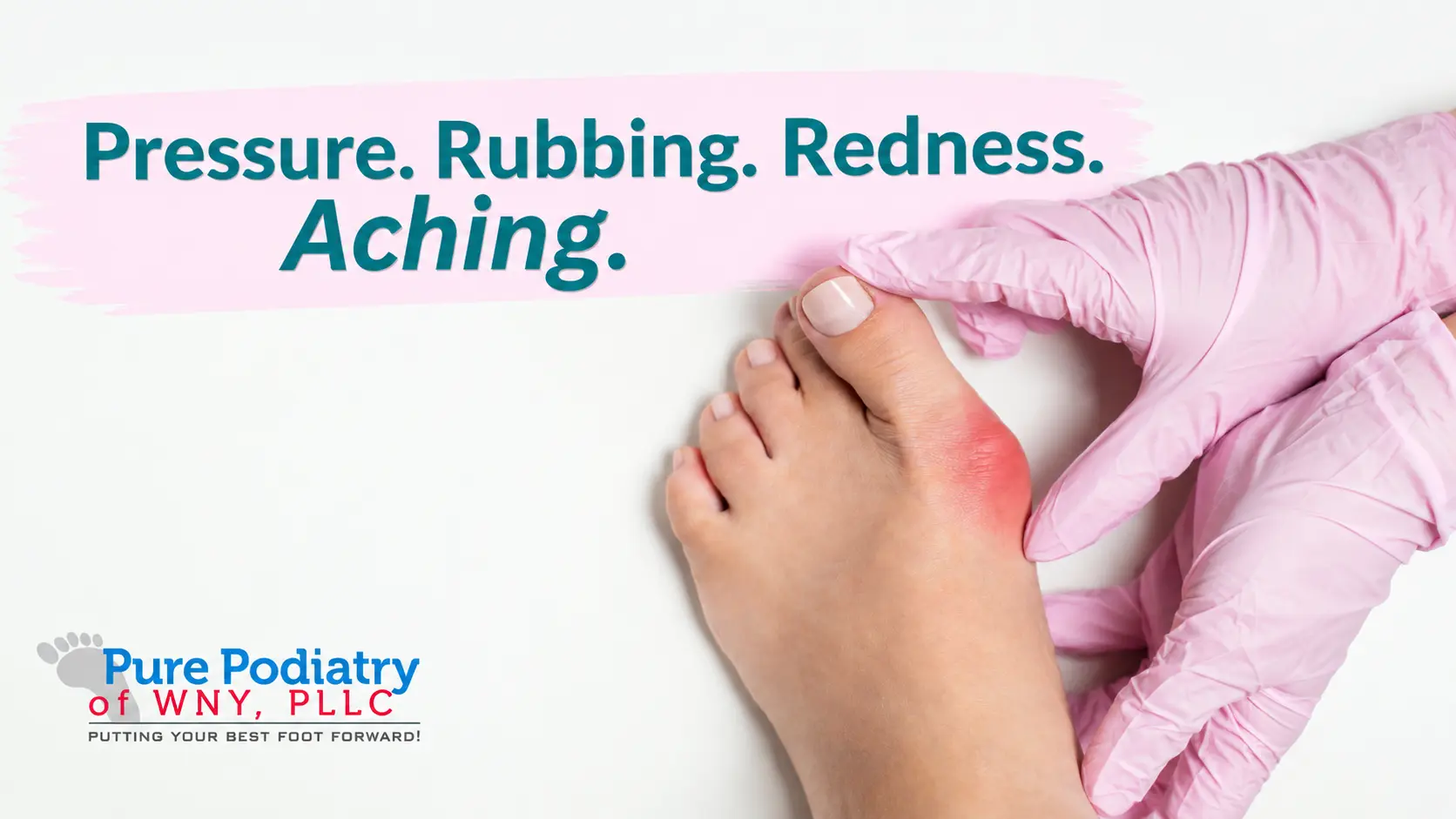
As the alignment of the big toe changes, it begins drifting toward the smaller toes. At the same time, the joint at the base of the toe can become increasingly prominent, creating the bump most people recognize as a bunion.
Although people often focus on the bump, a bunion isn’t simply extra bone growing on the side of the foot.
It involves a change in the alignment and mechanics of the foot.
Common bunion symptoms can include:
- Pain or tenderness around the big toe joint
- Redness and irritation
- Swelling around the joint
- Difficulty wearing certain shoes
- Stiffness or decreased movement in the big toe
- Corns or calluses from increased pressure or rubbing
- Crowding or changes involving neighboring toes
- Pain during walking or activity
Some people can have a bunion for years with relatively few symptoms. Others gradually find that their foot becomes more uncomfortable and increasingly limits their activities.
That’s why the question isn’t simply, “Do I have a bunion?”
A better question is:
“What is this bunion preventing me from doing?”
Do Bunions Get Worse Over Time?
Bunions can progress over time, although the rate and severity vary from person to person.
Because a bunion involves structural changes in the foot, the deformity generally does not correct itself on its own.
However, the appearance of the bunion isn’t the only thing that matters.
Pain, mobility, footwear limitations, changes in toe position, and the impact on your daily life can all help determine whether treatment should be considered.
Here are six signs your bunion deserves a closer look.
1. Your Bunion Pain Is Becoming More Frequent
Occasional irritation after wearing an uncomfortable pair of shoes is one thing.
Pain that keeps returning is different.
Maybe your foot used to hurt only after a long day. Now you’re noticing soreness during normal activities. Or perhaps the discomfort lasts longer after you’ve been on your feet.
Recurring bunion pain is worth evaluating, especially if you’re continually adjusting your routine to manage it. If you’re unsure when ongoing discomfort has become serious enough to seek professional care, our guide on when persistent foot pain is a sign you should see a podiatrist offers additional perspective.
Pain is your body’s way of telling you something isn’t working properly.
You don’t have to wait until the pain becomes severe before asking why.
2. Closed-Toe Shoes Are Becoming Harder to Wear
This can become particularly noticeable as summer turns to fall in Western New York.
During warmer weather, sandals and open shoes may put less pressure on the bunion. Then cooler temperatures arrive, and you return to sneakers, work shoes, and boots.
Suddenly, that bump feels impossible to ignore.
You may notice:
- Pressure against the side of the shoe
- Redness after taking your shoes off
- Burning or irritation around the bunion
- Difficulty finding shoes wide enough to feel comfortable
- Pain that increases the longer you wear closed-toe shoes
Changing footwear can sometimes reduce pressure and improve comfort. The American Academy of Orthopaedic Surgeons also provides guidance on how properly fitting shoes and adequate toe space can help reduce pressure on foot deformities such as bunions. Properly fitting footwear is also an important part of protecting your feet from other common problems, including skin conditions that can develop when the feet are exposed to repeated friction or irritation. You can learn more in our guide to preventing plantar warts and protecting your feet.
But if you’re constantly searching for shoes that won’t hurt, the underlying problem deserves attention too.
3. You’re Changing the Way You Walk
People are remarkably good at adapting to pain.
Sometimes too good.
Without consciously deciding to do it, you may begin shifting your weight away from the painful big toe, walking on the outside of your foot, taking shorter steps, or avoiding pushing off normally when you walk.
Those compensations can affect how your foot functions.
Your big toe plays an important role in walking and pushing your body forward. When pain or stiffness changes that movement, other parts of your foot and lower extremity may begin working differently.
If you’ve caught yourself limping or changing your stride because of bunion pain, schedule an evaluation.
4. Your Big Toe Is Becoming Stiffer or Changing Position
A bunion can affect both the position and movement of the big toe.
You may notice that the toe appears to lean farther toward the second toe than it used to. You might also find that bending the big toe becomes uncomfortable or increasingly difficult.
Changes in toe alignment can also contribute to crowding.
As the big toe shifts, neighboring toes may experience additional pressure, potentially contributing to rubbing, corns, calluses, or other toe problems. Changes in the skin of your feet should also be monitored, particularly when you notice a new growth or persistent area of concern; learn more about what causes plantar warts and how they can be prevented.
If you’re seeing noticeable changes in the shape or movement of your foot, don’t rely solely on how much it hurts.
Have the structure of your foot evaluated.
5. Your Bunion Is Limiting Your Activities
This may be the most important sign of all.
Ask yourself:
What have I stopped doing because of my foot?
Maybe you’ve stopped taking your evening walks.
Maybe you avoid certain workouts.
Maybe you’re hesitant to plan a day that involves a lot of walking.
Maybe you choose restaurants, vacations, shopping trips, or social activities based on how long you’ll have to be on your feet.
Or perhaps you can still do everything you want to do, but you know you’ll pay for it with foot pain later.
Foot problems can affect people of all ages and activity levels, and foot and ankle injuries can also keep young athletes from participating in the activities they enjoy.
Foot pain has a way of slowly shrinking someone’s world.
It doesn’t usually happen overnight. You make one small adjustment, then another, until accommodating your foot becomes normal.
It shouldn’t have to be.
If pain is affecting exercise, walking, or participation in physical activities, our sports medicine services can help evaluate foot and ankle problems affecting your mobility and activity.
6. You’ve Tried to Manage the Bunion Yourself, but It Still Hurts
If you’ve already changed shoes, reduced activities, tried padding, or made other adjustments and your bunion continues to bother you, it may be time for a more individualized approach.
The internet is full of products claiming to “fix” bunions.
But because a bunion is a structural problem, a brace, splint, spacer, or pad cannot simply make the underlying deformity disappear.
Some conservative approaches may help reduce symptoms or pressure, but treatment should be based on your individual foot structure, symptoms, activity level, and goals.
A podiatrist can help you determine which options actually make sense for you.
Can Bunions Be Treated Without Surgery?
Yes. Depending on the severity of your symptoms and the structure of your foot, nonsurgical bunion treatment may help improve comfort.
Conservative treatment options may include:
Footwear modifications: Shoes with a wider toe box may decrease pressure against the bunion.
Padding: Padding may help reduce rubbing and irritation in certain situations.
Activity modifications: Adjusting activities that repeatedly aggravate the joint may help manage symptoms.
Orthotics: Depending on your individual foot mechanics, orthotics may be recommended as part of a treatment plan.
These treatments are generally aimed at managing symptoms rather than reversing the structural bunion itself.
And importantly, seeing a podiatrist does not mean you have committed to surgery.
The right treatment approach depends on your individual symptoms, foot structure, activity level, and goals, which is why an evaluation with our experienced podiatry team can help you better understand your options.
When Does a Bunion Need Surgery?
Bunion surgery may be considered when pain significantly interferes with walking, normal footwear, daily activities, or quality of life and appropriate conservative treatments are no longer providing adequate relief.
There isn’t one universal point at which every bunion “needs” surgery.
The decision should be individualized.
Your podiatrist may consider your symptoms, foot structure, activity level, progression of the deformity, treatments you’ve already tried, and how much the condition affects your life.
If surgery becomes appropriate, understanding that earlier can also give you more control over timing.
You can plan around work, family responsibilities, travel, holidays, and other commitments rather than waiting until your foot becomes increasingly difficult to manage.
Why Fall Is a Good Time to Address Bunion Pain
Fall is when many Western New York patients become more aware of foot problems they’ve been accommodating all summer.
Closed-toe shoes return.
Schedules get busier.
People begin walking more at school activities, sporting events, fall festivals, travel, and everyday routines.
And winter isn’t far behind.
If you’ve been wondering whether you should finally do something about your bunion, September is a good time to get answers.
If conservative treatment is appropriate, you can begin exploring those options.
If surgery may eventually be worth considering, starting the conversation now gives you time to understand the procedure, recovery expectations, and potential timing before making a decision.
An appointment isn’t a commitment to surgery.
It’s information.
Frequently Asked Questions About Bunions
Can a bunion go away on its own?
A bunion is a structural deformity of the foot and generally does not disappear on its own. Conservative treatments may help manage symptoms and reduce pressure, but they do not typically reverse the underlying structural changes.
Does having a bunion mean I will eventually need surgery?
No. Not everyone with a bunion needs surgery. Treatment depends on your symptoms, foot structure, activity level, and how much the bunion affects your daily life.
What happens if I don’t treat my bunion?
Bunions can progress differently in different people. Some remain relatively manageable, while others become increasingly painful or affect toe alignment, footwear, and walking. A podiatric evaluation can help you understand your individual situation.
Should I see a podiatrist even if my bunion isn’t severe?
Yes, particularly if you’re experiencing recurring discomfort, difficulty with shoes, changes in toe position, or limitations in your normal activities. You do not need to wait for severe pain to get an evaluation.
Can a podiatrist help with bunion pain without surgery?
Yes. Depending on your symptoms and foot mechanics, conservative treatment options may be recommended to reduce discomfort and improve function.
You Don’t Have to Keep Working Around Your Foot Pain
There’s a difference between having a bunion and having a bunion that has started making decisions for you.
If you’re choosing shoes based entirely on your foot, avoiding activities you enjoy, changing the way you walk, or wondering whether you’ll be able to make it through another day comfortably, it’s time to get answers.
At Pure Podiatry of WNY, we take the time to understand what you’re experiencing, evaluate how your foot is functioning, and discuss treatment options based on your individual needs.
Sometimes that means conservative care.
Sometimes it means having a conversation about surgery.
But it always starts with understanding the problem.
Walk Into Fall More Comfortably
Don’t spend another season planning around bunion pain.
Schedule an appointment with Pure Podiatry of WNY to have your bunion or chronic foot pain evaluated and learn which treatment options may be right for you.